In UniAdic nos esforzamos cada día en brindar a nuestros pacientes y al público información adecuada, validada y seria en el tratamiento de las adicciones. En este artículo encontrará información relevante, útil y científica sobre cómo funciona la dopamina en lAddictions Madrid or, in other words, the functioning of the dopaminergic system in the limbic reward system.
THE IMPORTANCE OF DOPAMINE IN THE TREATMENT OF ADDICTIONS
DFor years now, we have felt an ethical and professional obligation to inform the various patients who come to us about the treatment options available for addiction. our clinic. During those initial sessions with a distressed patient who needs more information about why something they once “controlled” at a certain point in their life has become compulsive and addictive behavior. That is why we hope you will find the following article useful regarding how dopamine works in the addictions madrid.
Recently, he has focused on the addiction treatment desde el enfoque de la patología dual principalmente por dos razones. Por un lado, existe una importante explosión de desarrollo de psicofármacos con efectos procognitivos desarrollados para el tratamiento de enfermedades neurodegenerativas (enfermedad de Alzheimer) y el síndrome de déficit atencional. Por otro lado, la investigación en animales y en personas ha mostrado que la dopamina modula funciones cognitivas como la atención y la memoria de trabajo (Nieoullon, 2002). Por ejemplo, el papel de la dopamina en la memoria de trabajo y la acetilcolina en el área cerebral que se activa en los procesos de alerta y atención.
Algunos fármacos que actúan sobre estos neurotransmisores modifican el rendimiento en tareas cognitivas —el efecto depende de la dosis y de la persona, y su indicación corresponde siempre a un médico— dependientes de dominios cognitivos regulados por esos neurotransmisores. Estas investigaciones sugieren que es una posibilidad viable utilizar intervenciones farmacológicas sobre los neurotransmisores (como la dopamina) de manera aguda (en un breve periodo de tiempo). Para disminuir la pérdida de las funciones cognitivas acompañado por un tratamiento psicoterapéutico de rehabilitación cognitiva y de manejo de contingencias en addictions.
The role of neurochemical modulation of dopamine (NT) in higher cognitive functions provides an essential foundation for understanding how psychopharmacological intervention can reduce cognitive impairments in users of cannabis and cocaine. Or lead to greater dependence on various types of addictions, both substance-related and non-substance-related.
INFORMATION TRANSMISSION IN THE CENTRAL NERVOUS SYSTEM
NEUROMODULATORS, NEUROTRANSMITTERS, AND SYNAPSES
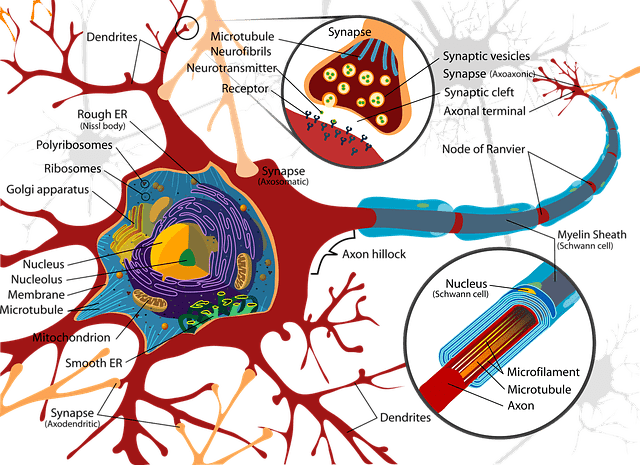
LThe primary function of nerve cells is to receive, transmit, and store information. To understand how dopamine works in addiction in Madrid, it is first important to recognize that there are different types of nerve cells that can perform some of these functions (such as glial cells), but only neurons have the ability to transmit information by forming neural networks. These networks, in turn, underpin cognitive abilities such as memory, attention, language, etc.
This is possible because neurons consist of the soma (or cell body), an axon that allows an action potential (AP) to travel from the cell body to distant parts of the neuron, and dendrites that receive information. Thus, the transmission of information between neurons occurs at points of contact between them called synapses. There are two types of synapses:
- Electric: These are in the minority and require direct contact to transmit the electrical impulse.
- Chemical: These are the most significant and make up the majority. They do not have direct contact but act through neuromodulators.
Psychopharmacology in Addiction
GENERAL PRINCIPLES
CAs we have discussed previously, in chemical synapses there are molecules (neurotransmitters or neuromodulators) at presynaptic sites located at the terminal ends of axons. When these molecules are activated (PA), they bind to receptors located at the postsynaptic sites on the dendrites. Thus, depending on the type of messenger and receptor, neurotransmitters produce either a rapid-onset, short-duration effect (you may recognize this sensation in feelings of joy or pleasure) or a slow-onset effect that lasts longer. To summarize, neurotransmitters (NTs)—such as dopamine, serotonin, etc.—are responsible for transmitting information. In contrast, neuromodulators have a postsynaptic function; that is, they modulate a neuron’s response to a neurotransmitter. Psychotropic medications for addiction are prescribed to act on neuromodulation, not on the transmitter or neurotransmitter itself. More than 100 NTs have been identified to date, but only a small number of them play a role in cognitive functions.
Neurotransmitters are divided into two main groups:
- Biogenic amines: acetylcholine, histamines, and monoamines (serotonin and catecholamines: dopamine, norepinephrine, epinephrine)
- Amino acids (GABA, glutamate, glycine).
DRUGS DAMAGE THE EXECUTIVE SYSTEM
BAD DECISIONS
AndDarwin said that the species that survives is not the strongest, but the one that best adapts to its environment. This ability requires suppressing irrelevant behaviors and better selecting new behaviors adapted to the environment and each person’s own goals. To accomplish this task, we need a malleable and flexible mind that updates and keeps relevant information from our environment active. In other words, it pays attention to relevant stimuli and ignores distractions—controlling our behaviors, selecting adapted behaviors, and inhibiting maladaptive ones.
This last task involves the extremely important ability to modify behavior in light of one’s environment and the consequences of one’s actions. Together, these functions are called “executive functions.” They must be “activated” when action routines—or, in other words, habits and previously learned activities—become insufficient for the task at hand.
These higher executive functions are what set us apart from other animal species and, in a way, define us as human beings. They include the mental abilities to set a goal, as well as the planning and execution of actions to achieve that goal—a set of complex tasks. These functions depend on three fundamental processes:
- Shifting, or switching between different tasks or mental processes.
- The inhibition of irrelevant automatic responses.
- The updating of mental representations in working memory.
In summary, we can say that executive functions are the ability to coordinate various cognitive processes to achieve a goal in a flexible manner (like an orchestra conductor). This is essential for behavioral adaptation and self-regulation. It shapes the way we act and respond through behaviors appropriate to the demands of our daily lives.
In this way, stress, alertness, motivation, mood, and information processing are affected by the substance use. Since they modulate the natural and adaptive response of the executive system, a family member or the patient themselves may begin to notice changes in mood or in what they considered to be their “normal” state while using a toxic substance. This supports the question of how dopamine functions in the addictions madrid.
THE DOPAMINERGIC SYSTEM IN ADDICTION
REWARD CIRCUIT
SMuch has been written about the role of dopamine in addictive processes, and how dopamine works in addiction in Madrid. We hope to shed a little more light on the subject. Primarily, at the neurofunctional level, dopamine is related to working memory. Thus, the effects of dopaminergic drugs (such as cocaine) son complejos y dependen del tipo de tarea y sistema neuronal asociado. La impulsividad es uno de los rasgos que más se ha relacionado con el funcionamiento dopaminérgico en las adicciones (Koob y Volkow, 2016), por su efecto diferencial en la memoria de trabajo y la actividad frontoestriada. La dopamina participa además en otras funciones cognitivas, como la flexibilidad mental y la planificación (Nieoullon, 2002) (elementos tan afectos en personas que padecen una addiction).
As explained above, our evolutionary system is designed to increase the frequency of behaviors that promote adaptation to the environment—and our success as living organisms. In this regard, how does dopamine function in the aMadrid Predictions (DA), as a neurotransmitter (NT), plays an essential role in the process. Every time the reward circuit is “fed” by a pleasurable experience that our brain interprets as “positive,” it tends to generate greater activation of the synaptic circuit by sending a signal that causes us to remember (working memory) and repeat it. This creates lasting changes in “connectivity” (like riding a bike) that require the involvement of the higher executive system (since it is a complex task).
Just as drugs release neurotransmitters (NTs) such as serotonin (we’ll discuss that later) and adrenaline, they also trigger an increase in the release of dopamine (DA). This reinforces the link between substance use and feelings of pleasure and experience. This association can last a long time, which is why professional help is necessary to change the setting and establish different habits (routines) that foster new synaptic connections. At this point, pharmacology can be a valuable support for prevent relapses in a addiction treatment Learning how dopamine works in addiction in Madrid.
Ricardo Rodriguez Suarez. Technical Coordinator UniAdic

MORE INFORMATION
In UniAdic, As a Comprehensive Addiction Treatment Center, our professionals address the issue from a holistic and in-depth perspective, taking into account the emotional factors that may contribute to the difficulty of setting boundaries and engaging in an activity compulsively.
UNIADIC – ADDICTION INTERVENTION UNIT–
It is a COMPREHENSIVE ADDICTION TREATMENT CENTERS. It features a professional team de médicos, psicólogos, educadores sociales y terapeutas especializados en adicciones con experiencia nacional e internacional. Como una UNIDAD privada de intervención, realiza colaboraciones en la Clínica López – Ibor in northern Madrid and on an outpatient basis at the center in Madrid, en el barrio de Chamberí. El método y programa terapéutico de UniAdic, comparte los últimos avances médicos y psicológicos, ofreciendo un enfoque adaptado a cada paciente en singular; en alcohol addiction treatments, cocaine addiction, sex addiction, heroin addiction, gambling addiction or compulsive gambling, emotional dependence, technology addiction, tobacco addiction, shopaholism, and other addictions—both substance-related and non-substance-related. As a partner of Emerge Healthcare Services Group.
Fuentes
- Nieoullon A. Dopamine and the regulation of cognition and attention. Progress in Neurobiology, 2002;67(1):53-83.
- Koob GF, Volkow ND. Neurobiology of addiction: a neurocircuitry analysis. The Lancet Psychiatry, 2016;3(8):760-773.
Would you prefer that we call you?
Déjanos tu nombre y teléfono y te llamamos. La atención es confidencial.
O llámanos al 919 931 645 · de lunes a viernes de 10:00 a 22:00 y sábados de 10:00 a 15:00.